application

Full Stack Software EngineerRust Enthusiast

what I do

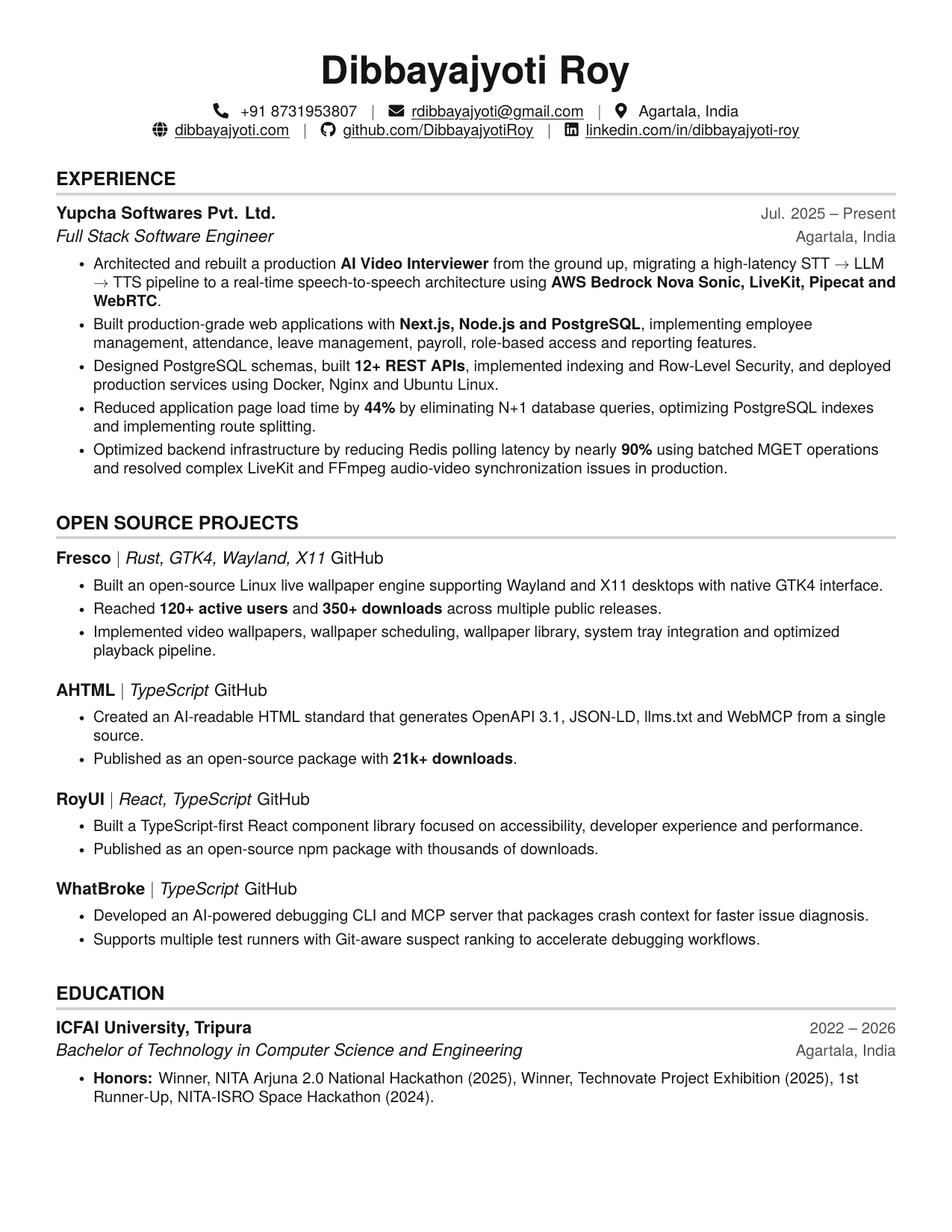
Hi, I'm Dibbayajyoti! I'm a Full Stack Software Engineer based in Agartala, India, currently working at Yupcha Softwares Pvt. Ltd. I focus on shipping production-grade SaaS platforms, integrating REST APIs, and building cutting-edge user-facing dashboards in Next.js. Beyond engineering, I have a deep interest in Next.js performance optimization, Core Web Vitals, Rust backend development, and modern design systems.

experience

Since July 2025 at Yupcha Softwares Pvt. Ltd, I've shipped HR SaaS modules — employee records, leave workflow, and role-based access controls — used across partner organisations. I designed 12+ REST endpoints in Node.js/Express with PostgreSQL, deployed services to Ubuntu VMs on a Proxmox cluster with nginx reverse proxies, Let's Encrypt TLS, and systemd supervision. I cut page load time from 3.4s to 1.9s (~44%) by eliminating N+1 queries, adding composite indexes, and splitting Next.js bundle routes.

projects

Klinder-OSS: An open-source SDK that unifies event tracking, error-based session recording, and automatic email trigger workflows in one install — replacing what teams normally stitch together with PostHog, LogRocket, and Customer.io. Typed events with Zod validation, edge ingestion on Cloudflare Workers + Queues, Neon Postgres with Row-Level Security for multi-tenant isolation, and a Rust port via workers-rs in progress targeting sub-10ms p95 latency.

Details →Open the demo →Compare vs PostHog

whatbroke: An open-source (Apache-2.0) terminal capture layer for local Node/TypeScript crashes. Wrap a dev command — whatbroke run npm test — and when it dies it packages the error, the diff since the code last worked, and a deterministically-ranked guess at the responsible file, secrets scrubbed by a mandatory redaction gate, then serves it to a coding agent (Claude Code, Cursor) over a read-only MCP server. The ranking intersects the crash stack with files changed since the last green commit — no LLM, no network, byte-identical output.

Details →npm →GitHub →

Roy UI: An open-source (MIT) React component library for dashboards, admin panels, and internal tools. It ships a batteries-included DataTable — search, date-range and time filters, sort, pagination, drag-to-reorder and edge-drag-resize columns, hide/restore, CSV/JSON import-export — plus a custom date range picker with no date-fns dependency and an analog/digital time picker. TypeScript-first, RSC-safe, tree-shakable ESM, sub-12 KB, zero config. A styled, install-don't-copy-paste alternative to shadcn/ui and TanStack Table for Next.js 15, Vite, Remix, and TanStack Start.

Details →Live docs →npm →GitHub →

AHTML: A shipped seven-package npm scope (@ahtmljs/*) at v0.9.0 for making web content cheaply consumable by AI agents. @ahtmljs/schema defines the canonical snapshot with RAG-ready Document.chunks; @ahtmljs/next and @ahtmljs/vite emit MCP, OpenAPI, JSON-LD, llms.txt, and the AHTML snapshot at /.well-known/ahtml.json with one config line; @ahtmljs/agent is the client SDK with ETag caching, dry-run safety gates, and hostile-agent regression tests; @ahtmljs/langchain turns any AHTML site into a LangChain.js Document[] with citation metadata; @ahtmljs/hono mounts the same emitter on any Hono runtime (Node, Bun, Deno, Cloudflare Workers, AWS Lambda); and @ahtmljs/cli ships ahtml doctor to validate the discovery chain in CI. 344 passing tests across the scope.

Details →npm scope →GitHub →Compare vs llms.txt

Diffcore: A fast Rust + WebAssembly JSON diff engine on npm — written in Rust, compiled to WASM, it returns real JSON Pointer paths and decoded values (not opaque hashes), emits standard RFC 6902 JSON Patch, and ships applyPatch / revertPatch, three-way merge, undo/redo, a React hook, and a CLI. In head-to-head benchmarks it is 2.3–3.0× faster than fast-json-patch and 4–8× faster than jsondiffpatch. The wedge: two of the four leaders in the JSON-diff market (fast-json-patch last shipped 2022, deep-diff last 2018) are effectively stale — Diffcore is the actively-shipped, RFC-6902-compliant alternative.

Details →npm install diffcore →Live demo →Compare vs jsondiffpatch

Learning Copilot: An AWS Bedrock-powered AI learning assistant with structured, level-adaptive explanations, auto-generated D2 diagrams, and real-time streaming responses. Engineered multi-model fallback (Nova Pro → Nova Lite) for resilience under rate limits. Cost-aware architecture with DynamoDB conversation memory (30-day TTL) and per-mode token budgets. Selected top 500 in the AI for Bharat hackathon.

Try it →

open source

I contribute upstream to tools I use — most recently replication diagnostics for ReductStore, a Rust time-series database: merged by the maintainer, shipping in v1.20.

Contributions + maintainer endorsement →PR #1417 →

npm

Each product's live npm download counts are on its own page — whatbroke, AHTML, Roy UI, Diffcore.

older work

BloodLink — blood donor / seeker matching platform with PostgreSQL geolocation, ~100 pilot users (2024). EMS — real-time Employee Management System in Rust and React. LunarSite — ML pipeline for lunar mineral prediction (NITA–ISRO 2024). CarbonFootprintTracker — sustainability calculator with smart recommendations.

skills

TypeScript, JavaScript, Rust, and Python. Frontend: React, Next.js, Tailwind CSS, TanStack Query. Backend: Node.js, Hono, Express, REST APIs, Server-Sent Events, Zod, OAuth, JWT. Infrastructure: Linux, Proxmox VE, nginx, systemd, Docker, Cloudflare Workers, AWS (Bedrock, DynamoDB, CloudWatch). Databases: PostgreSQL (Neon, RLS, partitioning), DynamoDB, MongoDB, Redis. AI/ML: AWS Bedrock, multi-model orchestration with fallback, streaming inference, prompt engineering, agent design.

honors

Hackathon wins including the NITA Arjuna 2.0 National Hackathon (2025) and the Technovate Project Exhibition. The full list of awards and recognition is on /about.

writing

Long-form engineering notes on production incidents, AI engineering with AWS Bedrock, Next.js SEO, and Rust + WebAssembly performance — read at /writing.

My Focus

My goal is to build software that is both robust and efficient. Rust has completely transformed my approach to engineering, moving me from just building "web apps" to designing reliable systems. I'd love to contribute to core infrastructure projects, high-performance engines, or any challenge that requires deep technical precision.


About Me

I started my journey with a curiosity for how things are built, which led me to a B.Tech in Computer Science at ICFAI University Tripura. Web development allows me to design things and share them with anyone, anywhere, instantly. Web always wins.


Why Rust?

I have a deep appreciation for Rust as a systems programming language. It's truly a Swiss Army knife—whether it's low-level hardware control, building high-performance 3D game engines, or developing blazingly fast async backend services and microservices, Rust delivers both safety and speed without compromise.

The strict compiler, the ownership model, and the zero-cost abstractions make it a joy to work with once you master it. I believe Rust is the future of infrastructure, and I'm constantly exploring its potential in WebAssembly, edge computing on Cloudflare Workers (workers-rs), and real-time systems.

Thanks for reading this. Love your work, keep it up!